
Missing information?
Do you have any additional information you would like to share about a soldier?
Submit- Full
name
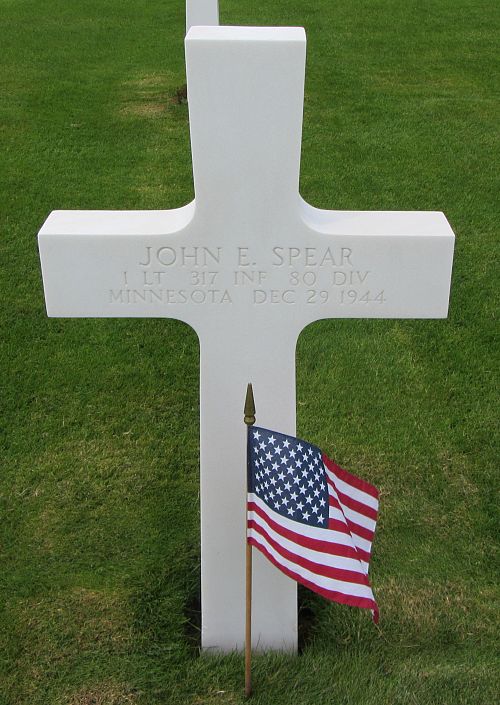
SPEAR, John E "Jack" - Date of
birth
6 January 1919 -
Age
25 -
Place of birth
Minnesota -
Hometown
Saint Paul, Ramsey County, Minnesota
Personal info
Military service
- Service
number
O-1321962 -
Rank
First Lieutenant -
Function
unknown -
Unit
317th Infantry Regiment,
80th Infantry Division
-
Awards
Purple Heart
Death
-
Status
Killed in Action - Date of
death
29 December 1944 - Place of
death
In the vicinity of Bourscheid-Heiderscheidergrund, Luxembourg
Grave
-
Cemetery
American War Cemetery Luxembourg
| Plot | Row | Grave |
|---|---|---|
| B | 8 | 7 |
Immediate family
-
Members
Charles M. Spear (father)
Agnes T. Spear (mother)
Wilfred F. Spear (brother)
Arthur J. Spear (brother)
Burton C. Spear (brother)
Eugene T. Spear (brother)
Donald J. Spear (brother)
Mary E. Spear (sister)
Charles M. Spear (brother)
Michael W. Spear (brother)
Biography
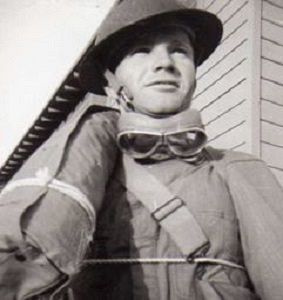
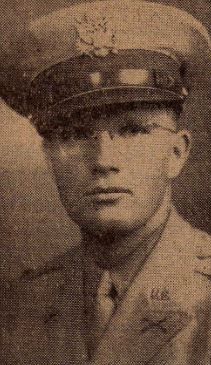
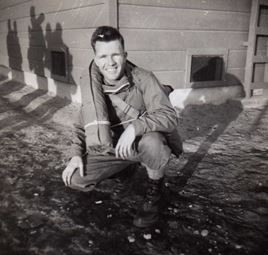
The following was written by Jack’s niece Elaine Howard in St. Paul Minnesota. Jack’s sister Mary Norton is Elaine’s mother. Treasure in the Basement I never knew him. My uncle, 1st Lt. John E. Spear, was killed in WWII during a battle in Luxembourg. The family called him Jack. A few years ago I came across a steamer trunk in my mother’s basement. It belonged to my uncle, Fr. Arthur J. Spear, nicknamed Bud. Bud had passed away a year earlier and I was curious about the trunk and what it might contain. When I asked my mother, she told me it was empty. Imagine my amazement when I opened it and found family letters dating back to 1935. These were letters from my grandmother to Bud, and he to her, along with letters from Jack to his brother Bud. As I read them, I was filled with an overwhelming respect for the trust they put in their God. My relatives were devout Catholics. Irish Catholic to the core. Most of the letters are typewritten and easy to read. As I sat on the basement floor reading, I was taken back to another time, the depression, the war and to a time where God was the center of this family’s existence. The first letter is dated 27 November 1935, the day before Thanksgiving. Jack is a high school student, age 16. He writes to his brother Bud telling him of a fishing trip he had recently taken to Lake Mitchell. He writes beautifully, describing the cold air of the cabin, fishing in the rain and catching and losing “the big one”. He was accompanied by two of his brothers, Charles and Burt. At the end of the war, it would be Charles, serving in the Graves Registration Service, who would by accident or providence, find the grave site of his brother Jack who was buried in Hamm, Luxembourg. Jack now rests in the World War II Luxembourg American Cemetery. This cemetery was established on 29 December 1944, the same day Jack died. The U.S. Third Army under General George S. Patton Jr. established it as a temporary burial ground for soldiers killed in the fighting in the Andennes hills north of the site. This battle is known as the Battle of the Bulge. A year later, on Christmas Eve, General Patton himself was buried in this same cemetery. In the next letter Jack wishes his brother a Merry Christmas and Happy New Year. The new year will bring in 1936. He hopes for a white Christmas and writes that the temperature is about right for snow. There will no tree this year he says, but the manger crib he made two years ago will take center stage. He goes on to describe its construction in detail. There would be no presents for this family. Their father, my grandfather, had died a few years earlier leaving my grandmother and nine children. There was little money, but their faith carries them. Jack writes, “Glory to God on the highest and Peace to men of good will”. I find it interesting that in a few years, he will go to war fighting to bring peace to the people of the war torn countries in Europe. It’s spring, 1937. Jack writes to Bud that he saw a robin that afternoon, a sure sign of Spring he says. He is writing this letter from the east-side bedroom on the second floor of their house at 1303 West Minnehaha in St. Paul, Minnesota. Bud shared this bedroom with his brothers for many years. Jack tells Bud he would not recognize the room because it has been refurbished and continues to describe the glossy floors and rose covered wallpaper, and the new paint covering the chipped radiator. He worries that it has cost too much money to redo this room, but with the wedding coming up, it had to be done. As I read this, I wondered who was getting married? A little research tells me it was my mother. Fall, 1937. Jack is 18 and graduated from Central High School. He has enrolled in the University of Minnesota, taking a class in literature. Bud had come home for the wedding that summer and Jack comments on the change he saw in his brother. He finds him not joyous, but content and writes that he thinks most men go through life undecided and doubtful about their work in the world. He prays for Bud’s courage and success. Jack has found a good paying job working for Jake Gillen. It’s a political job, but without advancement opportunities. He continues to answer ads looking to better himself. The letter moves on to the recent heavy frost that ended the beautiful garden in the backyard of the family home. Bud’s friend, Frank Bourne, a horticulturist, had sent tulips and other bulbs to the family and Jack had planted them the previous fall. He treasured them and other plants that Frank sent from Washington, DC. He writes “the Canna Lilly topped out at five feet, the marigolds were a brilliant orange-yellow, a color my eyes have never seen”. “However”, he says, “they could not compare to the brightness of the Asters and Salvia in fall”. I read these words again and wonder to myself how a modern 18 year old would interrupt them. Without knowing the man behind the words, would they think he was weak? Would Jack have been one of those students others bully? If they could look ahead a few years they would see Jack was a hero. A young man, so trusting in his God and his country that he enlists in the Army and dies on the battlefield. The next letter from Jack to Bud is undated. Jack has written a poem and expresses his desire to continue writing. “Maybe” he says, “as God looks into the future, He sees me writing for Him and in His name, perhaps he sees me explaining His words so that many will read them and know the truth”. Jack feels he has a gift from God, the gift to write and inspire others. The letters stop. I find an envelope at the bottom of all this correspondence. Carefully I take the contents out. It’s a Western Union telegram dated 15 January 1945 to my grandmother. “The Secretary of War desires me to express his deep regret that your son, First Lieutenant John E Spear was killed in action on Twenty Nine December in Luxembourg Confirming letter follows”. From attached documents I read that Jack had enlisted in the United States Army on 14 March 1942. He was twenty-three years old. He left for Europe November 1944. There is a letter from Leslie E. Dickson, CWO, USA, Headquarters 317th Infantry, dated 13 April 1945 explaining to my grandmother how Jack died. “ John was, at the time of his death serving his country as a Platoon Leader in a rifle company in the Infantry. On 29 December 1944, he was leading his platoon in an attack on enemy positions north of the town of Feulen, Luxembourg. It was during this attack that he was killed instantly by enemy artillery fire. He died so that others might live. He was given a Christian burial”. There are more letters in this envelope. Letters between my grandmother and Brigadier General John E. Rice, Headquarters and War Department Personnel Center, Camp McCoy, Wisconsin. The General writes that he also lost a son in the war. His son was an infantryman killed in the drive from Cassino to the Anzio Beachhead in Italy. The General writes that he was impressed with a poem that John wrote that was published in the Stars and Stripes newspaper and says that he keeps a copy of it under the glass on his desk. I find a tattered and aged newspaper clipping! General Rice used Jack’s poem in his separation letter to those who were discharged from the Army at Camp McCoy. “It is the finest expression of a soldier’s creed that I have ever seen” he writes. I find myself crying for the Uncle I never knew, for the God given talent that was lost that day he died. I feel proud of Jack. Proud that he knew all God’s people should be free and he was willing to give his life for his belief. It appears that Jack’s vision of being a writer came to fruition with the inspired verses of this poem. If You Keep Faith If you keep faith with me you need not weep If I am killed, for I will not complain Of any death if by it others gain. The things I think are worth my life to keep: The right to have, to know, to love, to speak. If all win these, I will endure my pain And on the battlefront, where I have lain, Will find an honored place in which to sleep. But if when peace returns to you once more You break the word you gave humanity By keeping not the pledge to which you swore, Then carve in stone this epitaph for me: “Here lies a fool who placed his hope in war and gave his faith to insincerity”. (Lieut. Jack E. Spear, Inf. 3rd Army KIA Dec. 1944 in the Ardennes)More information
The following story is written by Patrick Norton, Nephew of Lt. John Spear: "We were the proud custodian of Jack’s flag for many years. My mother was going to visit us for her 90th birthday and I wanted to do something special for her with regard to Jack.The city of Littleton had just finished our World War II Memorial. It is a beautiful site and has four monuments honoring the men and women that fought in the various theaters of WWII. During the construction of the memorial bricks were sold as a fund raiser. The brick could be engraved with the name of loved ones that served during WWII. We bought one for Jack and in addition to his name and rank we added the words “IF YOU KEEP FAITH’ from his poem. We were hoping that Jack’s flag could be raised and lowered on the memorial’s flag pole. I contacted our local VFW and asked them if they could perform a small flag ceremony for mother at the Littleton WWII memorial. They said that they would take care of everything and we should plan to arrive at 10:00 AM on 4 July 2003. It was very hot even at 10:00 in the morning. We brought a folding chair and an umbrella for mother but even that did not help too much.But the heat was soon forgotten when we saw the VFW Honor Guard in full uniform arrive for the ceremony. There were 12 VFW men with their ceremonial rifles. The VFW stood at attention and a bugler played reveille while Jack’s flag was raised.Then Jack’s flag was lowered while the bugler played taps.Then the VFW fired a three round salute from their rifles. Jack’s flag was ceremonially folded by the VFW. The spent cartridges from the gun salute were wrapped inside the flag as it was folded. Jack’s flag was then presented to mother by a VFW officer as he recited the words said to all recipients of a fallen soldier’s flag; As a representative of the United States Army, it is my high privilege to present you this flag. Let it be a symbol of the grateful appreciation this nation feels for the distinguished service rendered to our country and our flag by your loved one. The VFW had also notified the Denver Post newspaper of the ceremony and there was a reporter and a photographer at the ceremony. The photographer took many pictures and there was an article in the paper the next day. The article included a picture of mother receiving Jack’s flag and a copy of Jack’s poem ‘If you keep faith’."
Source of information: Raf Dyckmans, www.wwiimemorial.com, www.ancestry.com - 1940 census, Story of the 317th Infantry,
Patrick Norton
Photo source: www.findagrave.com - LuxAmCem, Patrick Norton