
Missing information?
Do you have any additional information you would like to share about a soldier?
Submit- Full
name
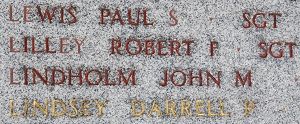
LILLEY, Robert Fred - Date of
birth
6 May 1921 -
Age
21 -
Place of birth
North Dakota -
Hometown
Belcourt, Rolette County, North Dakota
Personal info
Military service
- Service
number
17035867 -
Rank
Sergeant -
Function
Ball Turret Gunner -
Unit
68th Bombardment Squadron,
44th Bombardment Group, Heavy
-
Awards
Silver Star,
Purple Heart
Death
-
Status
Finding of Death - Date of
death
6 December 1942 - Place of
death
English Channel, 50°38'N - 01°-10'E
Grave
-
Cemetery
American War Cemetery Ardennes - Tablets of the Missing
Immediate family
-
Members
William J. Lilley (father)
Larose O. (Wilkie) Lilley (mother)
John J. Lilley (half-brother)
Charles H. Lilley (half-brother)
Marie E. Lilley (half-sister)
Norman Lilley (half-brother)
David L. Lilley (half-brother)
Gordon P.A. Lilley (half-brother)
Marie E. Lillie (sister)
Fred Lilley (brother)
Florence Lilley (sister)
Victoria Lilley (sister)
Plane data
- Serial
number
41-23786 -
Data
Type: B-24D
Destination: Abbeville, France
Mission: Bombing of the Drucat airfield
MACR: 2920
More information
Sgt Lilley's last names was also spelled as Lillie.He was a mechanic before he joined the Air Corps of the Regular Army at Fort Snelling, Minnesota on 26 November 1941.
The 44th BG took off to attack the Abbeville-Drucat Airdrome with six planes of the 68th leading the formation. However, a recall was sent out and the seven planes of the 67th, along with the six from the 66th responded by returning to base. This left the six planes of the 68th to go on alone as they did not hear the recall. With the two flights led by Capt Cramer and O'Brien, the squadron dropped 111 bombs on the target area and 20 additional bombs were salvoed over the target.
As the planes winged their way back from the target, they were attacked by thirty FW 190s in waves of two or three from dead ahead. Early in the encounter, the #4 engine of Lt. Dubard's ship was knocked out and the #3 engine damaged. The A/C valiantly attempted to keep in the formation because of the inherent dangers a single plane would encounter. Finally, the plane was forced to drop out of formation, with the #2 engine giving additional problems. The gunners of Lt. Dubard;'s ship gave fierce battle with their .50 caliber guns, and one FW 190 was seen to burst into flames. Shortly afterward, another enemy a/c was hit and it, too, crashed into the ocean. All of the enemy aircraft then concentrated their attacks on this ship while Lt. Dubard was vainly attempting to start #3 engine.
A third enemy aircraft was seen to be hit, burning, and with a part of the wing shot away and was claimed as a probably destroyed. At this time the enemy ceased their nose attacks on #786 and two of them attacked from dead astern and slightly below, holding their position which was just below the range of the top turret, for several seconds. The tail turret was seen to stop firing, pieces flew off, and the guns were dropped to their lowest position. The top turret also ceased firing and the plane dove toward the water. Before crashing, the Pilot was able to pull up the nose on several occasions, but when the plane hit the water, the nose was down, and it then broke into flames. At the time it hit the water, only #1 engine was still functioning.
This was the first loss of a plane and crew in Operational Flight for the 44th Bomb Group.
The entire crew of 10 was killed in action, and their remains were never found. The bombardier George A. Crawford is remembered at the Tablets of the Missing at Cambridge American Military Cemetery. The rest of the crew is remembered on the Tablets of the Missing at Ardennes.
Source of information: Raf Dyckmans, Peter Schouteten, Garnet Quigley, www.wwiimemorial.com, www.archives.gov, www.fold3.com - MACR
Photo source: Astrid van Erp