
Missing information?
Do you have any additional information you would like to share about a soldier?
Submit- Full
name
FOUNTAIN, George Thomas - Date of
birth
23 June 1919 -
Age
25 -
Place of birth
Highgate, Franklin County, Vermont -
Hometown
Westchester County, New York
Personal info
Military service
- Service
number
O1304058 -
Rank
Second Lieutenant -
Function
unknown -
Unit
26th Infantry Regiment,
1st Infantry Division
-
Awards
Purple Heart
Death
-
Status
Killed in Action - Date of
death
17 September 1944 - Place of
death
Hüttenwerk Rothe Erde
Aachen, Germany
Grave
-
Cemetery
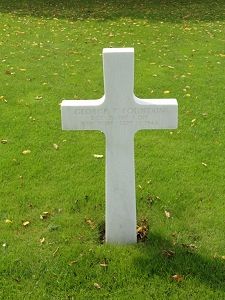
American War Cemetery Henri-Chapelle
| Plot | Row | Grave |
|---|---|---|
| G | 6 | 8 |
Immediate family
-
Members
George Fountain (father)
Bernice Fountain (mother)
Orill Fountain (brother)
John A. Fountain (brother)
Elisabeth Fountain (wife)
John S. Fountain (son)
More information
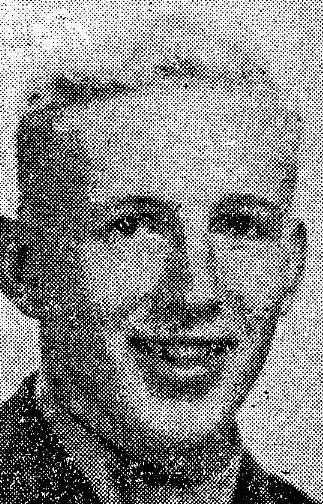
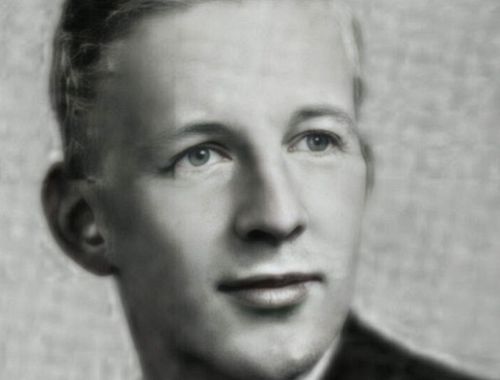
2nd Lt George T. Fountain graduated from St. Lawrence University in New York and was an accountant.He volunteered for the Army of the United States in Albany, New York on 17 February 1942.
The following article appeared in the German newspaper Aachener Zeitung on 8 July 2026:
It is September 17, 1944. A Sunday in late summer. There is war. American troops are fighting their way toward Aachen. A few days ago, they captured Kornelimünster. Via Brand, they are advancing toward Rothe Erde. The battle for the liberation of Aachen is taking shape. Shortly thereafter, in October, it will erupt. And with the capitulation on October 21 at 12:05 p.m.—announced by the city commander, Colonel Gerhard Wilck, who had only recently been appointed—Aachen becomes the first liberated city in Germany. But on that September 17, something happens that will change the lives of two families forever. To this very day. This is the story of a murder and an incredible search for clues. A story about war, peace, and reconciliation, from the ground up.
On this September 17, 1944, the families of Georg Born senior and his brother Hans Born are at home with their children. That home is a residential house that borders directly on a long industrial hall. Today, it is known as the monumental showpiece where the "Schrittmacher" dance festival took place for many years. Steel construction company Strang had its headquarters there for decades. The hall is one of the last remnants of the historic Hüttenwerk Rothe Erde in the east of Aachen. After its closure, Georg Born bought the hall and established his company there in 1929. For this Sunday, the families had intended to go to mass. "But towards morning, there was shooting again, and it was too dangerous to go," writes 16-year-old Marianne, daughter of Georg Born—later she would be called Schmetz—in her diary.
It is shortly after 10 o'clock this morning when there is a knock on the door. The family opens it. Three men are standing in the hallway, American soldiers. "Good morning," echoes through the house. The soldiers, led by a young lieutenant, are on patrol and want to search the production facility for German soldiers. The Borns assure them that there are none. The soldiers are quite friendly. Marianne Born writes in her diary: "Even if the Americans showed themselves to be decent people, at least they were our enemies." The soldiers are led to the upper floors of the apartment complex. The lieutenant opens a window on the second floor and surveys the situation. Everything is silent. Finally, as the eyewitness describes it, he takes off his helmet, says something to his comrades, laughs, sits down on the windowsill, and lights a cigarette.
Then a shot breaks the silence. The bullet hits the lieutenant in the head. He tilts forward. He is dead instantly. Marianne Born falls down the stairs, but none of the families are injured. The lieutenant's two comrades also flee to the factory hall's shelter, leaving their dead comrade behind. What would happen now? A firefight? Revenge on the families present? None of that. According to the witnesses' descriptions, the dead man's comrades remain friendly—completely incomprehensible to the residents. A few hours later in the afternoon, they arrive with other soldiers, retrieve the body, and thank the residents for placing a pillow under the dead man's head. What remains are two Aachen families traumatized by this shocking event. Almost exactly 78 years later, on September 18, 2022, another Sunday. Georg Born junior, grandson of founder Georg Born, receives a visit from his aunt Irmgard Gläßer, née Born. He visits the former residential building in the Rothe Erde industrial estate, which is now a monument. Irmgard Gläßer was born there on September 4, 1933. While the nephew and his aunt stand by that window in the hallway, the eyewitness tells the story of the young American soldier who died there. Georg Born is deeply moved by this story; he cannot get it out of his head: "After Irmgard's visit, I wondered if a name could not be given to this soldier, to whom it is also grateful that we can live in peace and freedom here in Germany today." But given the thousands of American soldiers who fought in Europe, how is it possible to find the one who was shot at this window on September 17, 1944?
Two years later. On October 21, 2024, Georg Born reads the Aachener Zeitung. It contains an article with the headline: "Why a tree in the Aachen forest bears the name of an American soldier." It concerns the inscription "Aiello USA 09 13 44" in the bark of an old beech tree. Judging by the date, that inscription was carved into the bark of the Born family in Rothe Erde four days before the events at the Born family's home. In this case, the Aachen doctor and former professional soldier Roland Böhm went looking for that "Aiello." With the help of Dutch experts, he found him: Sergeant Joseph Aiello. He was even able to speak with him from his home near New York. And after reading the article, Georg Born takes action.
The search for the young lieutenant begins. Born contacts Roland Böhm. He puts him in touch with Arno Lasoe from Heerlen, who works through the history and can draw from his enormous archive of data, documents, and photos. Lasoe, in turn, brings his colleague Harrie Bergers from Maastricht on board. The search for the needle in the haystack begins. Since a few puzzle pieces are on the table, there is great confidence in determining the identity of the shot soldier: according to eyewitnesses, the victim was young and blond, with the rank of lieutenant, shot in the head on September 17, 1944, likely a soldier of the 16th, 18th, or 26th Infantry Regiment of the 1st Division "Big Red One," which was deployed south of Aachen. Time of death 10:00 AM, body collection 3:00 PM. The experts check burial records from the former military cemetery Fosses-la-Ville near Namur in Belgium, where the division's fallen are buried. They encounter Warren E. Gay for the first time, who was killed on September 17, 1944. But there are things that don't fit. The soldier was a Private First Class and not a Lieutenant, and he had dark hair and was thirty years old. Then the big lead. It is in the minutes of the 26th Infantry Regiment from September 17. At 10:15 a.m., it was stated that the patrol had reached its objective, where patrol leader Lieutenant Fountain was killed. Another piece of evidence: under the keyword "Killed in action," killed in action, there is also a report in another protocol stating that a George T. Fountain was shot by a "sniper." Lieutenant Fountain, I mean. The search continues. The experts find a "Funeral Report," a burial certificate dated September 18, 1944. It states that George T. Fountain was buried that day at 5:00 p.m. at the Fosses-la-Ville cemetery. He died on September 17 from a gunshot wound to the head. Arno Lasoe and Harrie Bergers find even more. For example, the army registration card from 1940. It shows that Fountain was born in Vermont on June 23, 1919. More details can be found in an article in a local newspaper in Vermont. Title: "Lieutenant Fountain killed in action near Aachen". We learn that the young man began his service in 1942, subsequently underwent officer training, and came to Europe in mid-1944, first to England. We read that the young George Thomas was a student at St. Lawrence University in New York, graduated as an accountant in 1942, shortly before joining the army and living in New Jersey. We learn that his father, George Orill Fountain, was stationed in Corsica at the time.
In the process, you learn that he leaves behind his wife Elisabeth and his son John Stuart Fountain. His child was born on August 18, 1944, and must now grow up without the father, who never saw him. That same John Stuart Fountain later marries Donna Jean. They also have a son: Thomas "Tom" Dean Fountain, born on June 18, 1976. Those who look further here will discover this: the son of Lieutenant George Thomas Fountain passed away in 2009 at the age of 65.
The grandson, Tom Fountain, has meanwhile made a significant career. At Stanford University in California, one of the world's leading research universities, he earned no fewer than three master's degrees – in electrical engineering, computer science, and business administration. After various management positions, including at the globally renowned antivirus software maker McAfee, he is now the Chief Operating Officer of the American computer company F5, with nearly 8,000 employees.
June 26, 2026, a Friday. Aachen is sweating in an almost unbearable heat. A man stands by the window of the house next to the steel construction hall with his ten-year-old daughter; he looks along Philipsstraße, towards the former administration building of the Englebert tire factory. That striking red brick building at the roundabout to Hüttenstraße. It lies a few hundred meters away. From there, Georg Born has reconstructed, the sniper must have fired back then. The man at the window is Tom Fountain. He is standing exactly at the spot where, nearly 82 years earlier, a bullet killed his grandfather. Georg Born invited him. He came with his wife Kristin and his daughter Kaitlin. What does that do to you? And what went through his mind when he received the email from Aachen? "It cannot be put into words," says Fountain with tears in his eyes. All this time, the family had not known what really happened back then. And now this. Georg Born contacts Tom Fountain in January 2025. He writes him this story about George Thomas Fountain, who was shot dead in his grandfather's house. And he receives an answer. Tom Fountain writes that his father, who in turn never knew his father, had tried for years to find out more about him. So he came to visit.
Archives to trace the path of George Thomas, known as Tommy, in the army. Yet much remains unclear to the family. At seventeen, Tom, who was given his first name in memory of his grandfather, traveled with his father to his homeland. There is even a photo of the blond boy hanging at school. And you meet people who knew him from that time. It is also known that two soldiers visited his grandmother in New Jersey after the end of the war and offered their condolences. It was likely those two comrades who were out with him in Aachen on that fateful Sunday morning. And now this post from Germany, which writes a piece of family history for the Fountains.
On this day, someone else comes to visit. Irmgard Gläßer. The girl who was eleven at the time and witnessed the horrific events of 1944 up close; the family member whose story initiated the search. Without her, this—you could safely say—historic meeting would not have taken place. Irmgard Gläßer is now 92 years old. She remembers exactly what happened that day. She is listening to a lecture about it, and about the extraordinary search for the story behind the story, given by Georg Born. Together with Tom Fountain, she thoughtfully examines a small metal plaque that has since been made. At the top it reads "Paths against Forgetting," and it serves as a reminder of what happened in that house on the current Philipsstraat. The families from Germany and the US embrace each other.
Later on this hot Friday, we head to Henri-Chapelle. In the Belgian town, 20 kilometers from Rothe Erde, you will find a large American military cemetery. Approximately 8,000 fallen soldiers have found their final resting place there, thanks in part to whom the Borns and Fountains can gather in peace today. One of them was the young Lieutenant George Thomas Fountain, who was reburied there from Fosses-la-Ville. Block G, row 6, grave 8. This is the place where the circle is closed. The fallen soldier from the Borns family has a name. And his descendants a place of remembrance. International recognition regarding the graves. In this story, she comes to life.
Source of information: Peter Schouteten, Raf Dyckmans, Carla Mans, www.archives.gov, www.ancestry.com - 1930 Census / WWII Enlistment Record / U.S. WWII Draft Cards Young Men, www.history.army.mil/html/bookshelves/resmat/ww2list.html
Photo source: www.findagrave.com - Des Philippet / Jeanne Sutherland