
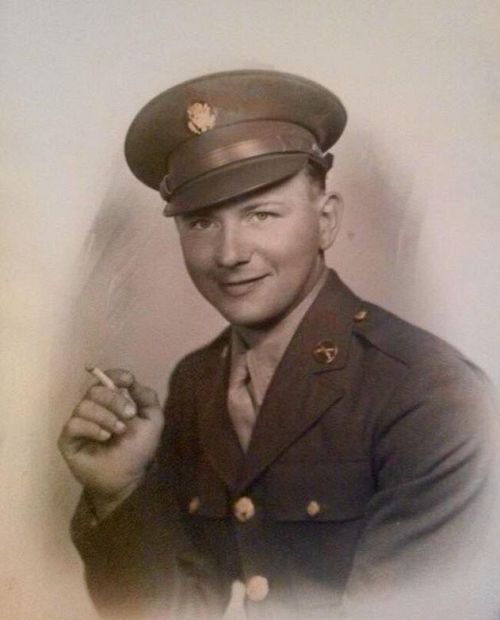
Missing information?
Do you have any additional information you would like to share about a soldier?
Submit- Full
name
ROPIAK, George V - Date of
birth
30 April 1920 -
Age
26 -
Place of birth
Chicago, Cook County, Illinois -
Hometown
Chicago, Cook County, Illinois
Personal info
Military service
- Service
number
36604335 -
Rank
Private First Class -
Function
unknown -
Unit
B Company,
309th Engineer Combat Battalion,
84th Infantry Division
-
Awards
Purple Heart with Oak Leaf Cluster
Death
-
Status
Missing in Action - Date of
death
3 May 1946 - Place of
death
In the vicinity of Wittenberg, Germany
Grave
-
Cemetery
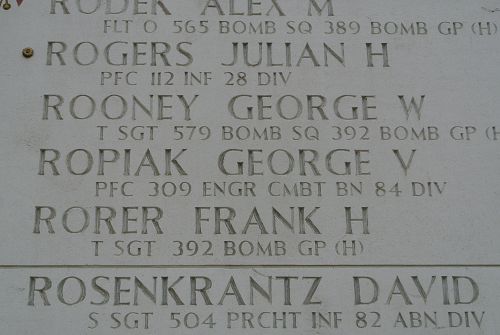
American War Cemetery Margraten - Walls of the Missing
Immediate family
-
Members
Joseph Ropiak (father)
Cecelia Ropiak (mother)
Violet Ropiak (sister)
Loretta Ropiak (sister)
Virginia Ropiak (sister)
Joseph Ropiak (brother)
John Ropiak (brother)
Rosetta (Randazzo) Ropiak (wife)
More information
George Ropiak enlisted in chicago, illinois on 2 September 1942.He was reported missing after he became separated from a group of American engineers and photographers that had crossed the Elbe river near Wittenberg, Germany. He was declared officially dead one day and one year after he was reported missing in action.
The circumstances of his loss are as follows: By the first of May 1945, the 84th Infantry Division - among many other American ground units - had reached the Elbe River in eastern Germany. The war in Europe was nearly over and many
American soldiers were processing prisoners, reestablishing German infrastructure, and
eliminating the final pockets of fanatical enemy troops. East of the river, only a few miles away,
Soviet units approached, destroying the last remnants of German resistance. The Soviet advance caused panic among German soldiers and civilians in the east. Allied troops found thousands of German refugees fleeing to the western side of the Elbe, desperate to be captured by American
forces rather than risk their fate at the hands of the Soviets. In the 84th Infantry Division sector,
near Wittenberg, American combat engineers even dispatched boats to the east side of the Elbe to evacuate German refugees to the American lines
On 2 May 1945, three photographers from the 84th Infantry Division set out on a mission to
cross the Elbe River a few miles south of Wittenberg. Available documentation does not explain exactly what the photographers hoped to accomplish, but it appears that they intended to capture the division’s first contact with Soviet troops in that area—the meeting of the East and West fronts at the Elbe. One indication of this is that F/Sgt Christian Blaser, Company B, 309th Engineer Combat Battalion, was instructed to send PFC Ropiak along with the photographers to act as an interpreter for the Russian soldiers.
The photographers, Pfc Ropiak, and T/5 Roy Vertrees (another combat engineer who likely served as the boat operator) climbed into an assault boat in the Elbe River and set off for the eastern shore. First Sergeant Blaser later reported that “Russian artillery and mortar fire became more intense” in the area. Nonetheless, the boat motored across the river and toward a mass of fleeing German refugees.
Once on the eastern shore of the Elbe, the group found a situation in chaos. A report regarding
his loss noted that “the Germans were apparently panic-stricken and made desperate attempts to be captured by the Americans. Many of them were drowned because of the extremely swift current of the Elbe River.” Within this confusion, Pfc Ropiak became separated from the photographers and T/5 Vertrees. He was last seen “walking among many German soldiers
headed in the direction of the Russian soldiers.”
Despite their efforts, T/5 Vertrees and the photographers could not find Pfc Ropiak. The group eventually returned to the boat and crossed back to the American side of the river.
Later that afternoon, when 1st Sgt Blaser assembled his platoon to move to a new area, T/5 Vertrees reported that Pfc Ropiak was missing and still on the eastern side of the river. The first sergeant ordered one of his men to cross the river and search the eastern bank. When that soldier’s search proved unsuccessful, 1st Sgt Blaser and two men conducted their own search on both sides of the river. They also found no trace of Pfc Ropiak. The first sergeant notified the platoon commander, who personally conducted a search in a motorboat up and down the Elbe for more than an hour. All three searches on 2 May 1945 - the day of Pfc Ropiak’s disappearance - were unsuccessful.
The next day, 3 May 1945, 1st Sgt Blaser returned to the riverbank with a group of soldiers and performed a fourth search. The group also checked with local medical units and asked other people in the area if they had any information regarding Pfc Ropiak’s whereabouts. None of these efforts were successful.
The Army declared Pfc Ropiak missing as of 2 May 1945. The War Department received no
further information about his disappearance. One Army investigation of his loss concluded that “due to the extremely complex situation, taking into consideration the artillery, mortar and small arms fire delivered by the Russian forces, in addition to hundreds of panic-stricken German soldiers and civilians making desperate attempts to cross the swift-flowing river there are many possibilities that Pfc Ropiak may have been accidentally killed by friendly Russian fire, or may have drowned in the nearby Elbe River.” The report also suggested that he may have been detained by Soviet forces. However, the 84th Infantry Division interacted with the Russians for several days along the Elbe in May, and photographs of these meetings—presumably taken after Pfc Ropiak’s loss - show high morale and friendly exchanges between the Americans and Soviets. The Russian units did not provide any information about Pfc Ropiak, suggesting that he was not detained or otherwise alive with them.
On 3 May 1946, a year and a day after his loss, Army investigators reviewed the details of his
case. They determined that since all efforts to locate Pfc Ropiak had failed, and that there had
been no indication during the previous twelve months that he had survived his disappearance on 2 May 1945, officials could reasonably presume he was deceased. That same day, the War Department issued a presumptive finding of death for Pfc Ropiak, according to Section 5 of the Missing Persons Act.
Following the end of hostilities, the American Graves Registration Command (AGRC), U.S.
Army Quartermaster Corps, was the unit tasked with investigation and recovery of missing
American personnel in the European Theater. In September 1948, AGRC investigators went to Wittenberg, Germany, to locate the remains of Pfc Walter B. Schiffens—another member of the 309th Engineer Combat Battalion lost on 2 May 1945. His loss was unrelated to Pfc Ropiak’s disappearance (Pfc Schiffens was aboard a boat that overturned while transporting German
prisoners of war across the Elbe, and he presumably drowned), but their last known locations were both around Wittenberg and had occurred the same day. The area was under Soviet control in 1948, which meant that the AGRC team was escorted by Soviet officers. Despite the careful Soviet monitoring of the team, the American investigators were able to interview several local residents and canvass the Wittenberg area for any information regarding American remains that washed ashore in the Elbe or were buried in local communities. The search was unsuccessful, as none of the German officials in the region, or local residents, knew of American remains in the region.
A second AGRC team investigated PFC Schiffens’ loss around Wittenberg in November 1948.
This effort focused on the western side of the Elbe. Like the previous investigation, none of the
local officials interviewed by the AGRC knew of American remains recovered from the river or
buried nearby.13
Medical technicians examined all unidentified remains recovered from the area during the war
and during later investigations. Thousands of unknown remains had been collected by the AGRC
across northern Europe. These unidentified remains, often consisting of only partial bodies or
skeletons, were labeled with an “X” and a number. These are commonly referred to as “X-files.”
Many of the remains were positively identified, usually through dental records. Others remained
unknown despite AGRC attempts to make identifications. Technicians compared the details of
these unknown X-files with the details of PFC Ropiak’s loss, but no favorable associations
resulted from these comparisons.
On 14 March 1949, having received no further evidence that could lead to the recovery PFC
Ropiak’s remains, a board of officers recommended that his remains be declared NonRecoverable.15
The War Department approved the recommendation on 13 May 1949.
However, Cold War tensions with the Soviet Union were hampering AGRC investigations. The
fate of Berlin was a particular flashpoint in the burgeoning conflict, and Wittenberg lay inside
the Soviet occupation zone. In 1950, the USSR had turned its occupation zone into the nominally independent German Democratic Republic (“East Germany”), a state that was implacably hostile to American interests, including the recovery of war dead. The AGRC was thus largely shut out of eastern Germany, with little prospect for permission for future
investigations. Therefore, in 1951, the War Department added Pfc Ropiak’s case to the
“Deferred Search Roster,” which suspended any final determination of his status. In early 1953, after there had been no further progress regarding Soviet relations in eastern Germany, the Army reviewed the Pfc Ropiak’s case and determined that the 1948 investigations sufficiently proved that his remains were non-recoverable, and his name was deleted from the Deferred Search Roster. The 1953 Army review added one detail not previously mentioned in the earlier Army reports of Pfc Ropiak’s loss. The analyst wrote that when members of the 309th Engineer Combat Battalion conducted the final search for Pfc Ropiak, on 3 May 1945, they received “assistance of the Russians.” None of the other reports in the IDPF claim that that Russians were involved in the initial searches for Pfc Ropiak, so it is unclear where the 1953 investigator received this information.
Historians at the Defense POW/MIA Accounting Agency (DPAA) are researching cases of American service members missing from combat across Germany. This effort includes searching for new leads regarding possible burial locations, as well as comparing the case details to still-unidentified remains previously recovered by AGRC teams, which are currently buried in American cemeteries. Unfortunately, it is not clear exactly how or where Pfc Ropiak died. Since he was serving as a Russian interpreter for the group of photographers, and last seen walking toward the Soviet line in the midst of the fleeing Germans, there is a strong possibility that he was accidentally killed by Soviet fire. It is unlikely that Soviet troops would have captured or intentionally killed him, as the American and Soviet armies were allies and the meeting of those two armies along the Elbe was generally celebrated by both sides. If he was accidentally killed by Soviet fire, it is possible that he was buried by Soviet troops along with other casualties (likely German) in the area. If this occurred, it is not clear why this information was not properly reported to American officials when Soviet troops met with them only days later.
It is also possible that Pfc Ropiak was not killed by Soviet fire, but died while crossing the Elbe
River to return to American lines. This scenario is less likely, but several dozen German refugees did drown during their frantic attempts to reach the western shore—some of which likely had been on overloaded boats that overturned.
Overall, Pfc Ropiak’s ultimate fate is not
known. It is only clear that he most likely died near Wittenberg and American forces could not
find his remains. Historians from DPAA periodically will try to gather more information about possible grave sites around Wittenberg. In the meantime, any new information from third party researchers or organizations received by DPAA related to isolated burials near Wittenberg region will be compared against the details of his loss for possible correlation. Overall, this case is considered “Active Pursuit” by DPAA.
To support the research for the remains of Pfc Ropiak, family members have donated DNA samples.
Source of information: Leo Minne, Terry Hirsch, Illinois, Cook County Birth Certificates, 1878–1922, www.abmc.gov, www.ancestry.com - 1940 Census / Cook County Illinois Marriage Index, 1930-1960, DPAA Case Summary
Photo source: Peter Schouteten, Roy Carlson (nephew)